Sleep Apnea Monitoring - SAM™

Gestión proactiva de las comorbilidades. Detección temprana, reducción prolongada de los riesgos. 1–6

Home Healthcare Professionals-Our Products Sleep Apnea Monitoring

APNEA DEL SUEÑO + COMORBILIDADES CARDIOVASCULARES

= UNA COMBINACIÓN PELIGROSA

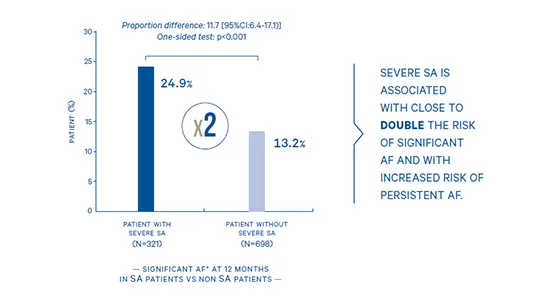
La apnea del sueño grave está fuertemente asociada a las comorbilidades cardiovasculares, y tiene un impacto negativo sobre ellas:

  • 58 % más de riesgo de insuficiencia cardíaca2
  • El riesgo de fibrilación auricular es 4 veces mayor3
  • Más resistencia al tratamiento farmacológico4
  • Mayor recurrencia de fibrilación auricular después de la ablación o cardioversión5,6

LA APNEA DEL SUEÑO ES MUY PREVALENTE AUNQUE ESTÁ INFRADIAGNOSTICADA.7–9

    • Se identificó carga severa de apnea del sueño (IRD >20) en el 31,1 % de pacientes de una población con marcapasos no seleccionada9
    • El 50-90 % de los pacientes no están diagnosticados y, por tanto, no se encuentran en tratamiento8
Sleep Apnea Monitoring SAM proposal bis 1

PROTECCIÓN DE LOS PACIENTES CON SAM

SAM es una exclusiva herramienta para el control de la apnea del sueño (Sleep Apnea Monitoring), que se ha validada frente al método de referencia: el índice de apnea hipopnea determinado por la polisomnografía.1

SAM es una herramienta de cribado fiable con una especificidad alta del 85 % y una elevada sensibilidad del 89 %.

Seguimiento rápido y eficiente

SAM detecta y notifica la apnea grave del sueño, permitiendo un seguimiento rápido y eficiente para manejar este peligroso trastorno.1

Sleep Apnea Monitoring SAM dream study 1

La disponibilidad de algunos productos y de sus funciones varía de un país a otro. Consulte a su representante para más información.

Productos relacionados:

ENO ; TEO ; KORA 250; KORA 100; REPLY 200; REPLY CRT-P

REFERENCIAS

  1. Defaye P, et al. A pacemaker transthoracic impedance sensor with an advanced algorithm to identify severe sleep apnea: The DREAM European study. Heart Rhythm. 2014;11:842–8.
  2. Gottlieb DJ, Yenokyan G, Newman AB et al. Prospective study of obstructive sleep apnea and incident coronary heart disease and heart failure: the sleep heart health study. Circulation. 2010;122:352–60.
  3. Mehra R, et al. Association of nocturnal arrhythmias with sleep-disordered breathing: The Sleep Heart Health Study. Am J Respir Crit Care Med. 2006;173:910–6.
  4. Monahan K, et al. Relation of the severity of obstructive sleep apnea in response to anti-arrhythmic drugs in patients with atrial fibrillation or atrial flutter. Am J Cardiol. 2012;110:369–72.
  5. Kanagala R, et al. Obstructive sleep apnea and the recurrence of atrial fibrillation. Circulation. 2003;107:2589–94.
  6. Ng CY, et al. Meta-analysis of obstructive sleep apnea as predictor of atrial fibrillation recurrence after catheter ablation. Am J Cardiol. 2011;108:47–51.
  7. Bradley TD and Floras JS. Obstructive sleep apnea and its cardiovascular consequences. Lancet. 2009; 373: 82-93.
  8. Lee W, et al. Epidemiology of Obstructive Sleep Apnea: a Population-based Perspective. Expert Rev Respir Med. 2008;2:349–64.
  9. Marti-Almor J et al. Incidence of sleep apnea and association with atrial fibrillation in an unselected pacemaker population: Results of the observational RESPIRE study. Heart Rhythm 2020;17(2):195-202 pii: S1547-5271(19)30822-7. doi: 10.1016/j.hrthm.2019.09.001.