REPLY

Natural intelligence.

Home Healthcare Professionals-Our Products Cardiac Rhythm Management Pacemakers REPLY

REPLY

Familia de marcapasos inspirada en la naturaleza. Inteligencia natural.

El marcapasos bicameral más pequeño del mundo, con una excelente longevidad. 1–3

Reply DR includes SafeR, the only AV management algorithm proven to be effective and safe for all of your patients with bradycardia.1, 4

12 años de longevidad en solo 8 cc.

The world’s smallest dual-chamber pacemaker with no compromise on longevity.1–3

REPLY REPLY DR Micro Port 2018 1
Safer

SafeR™

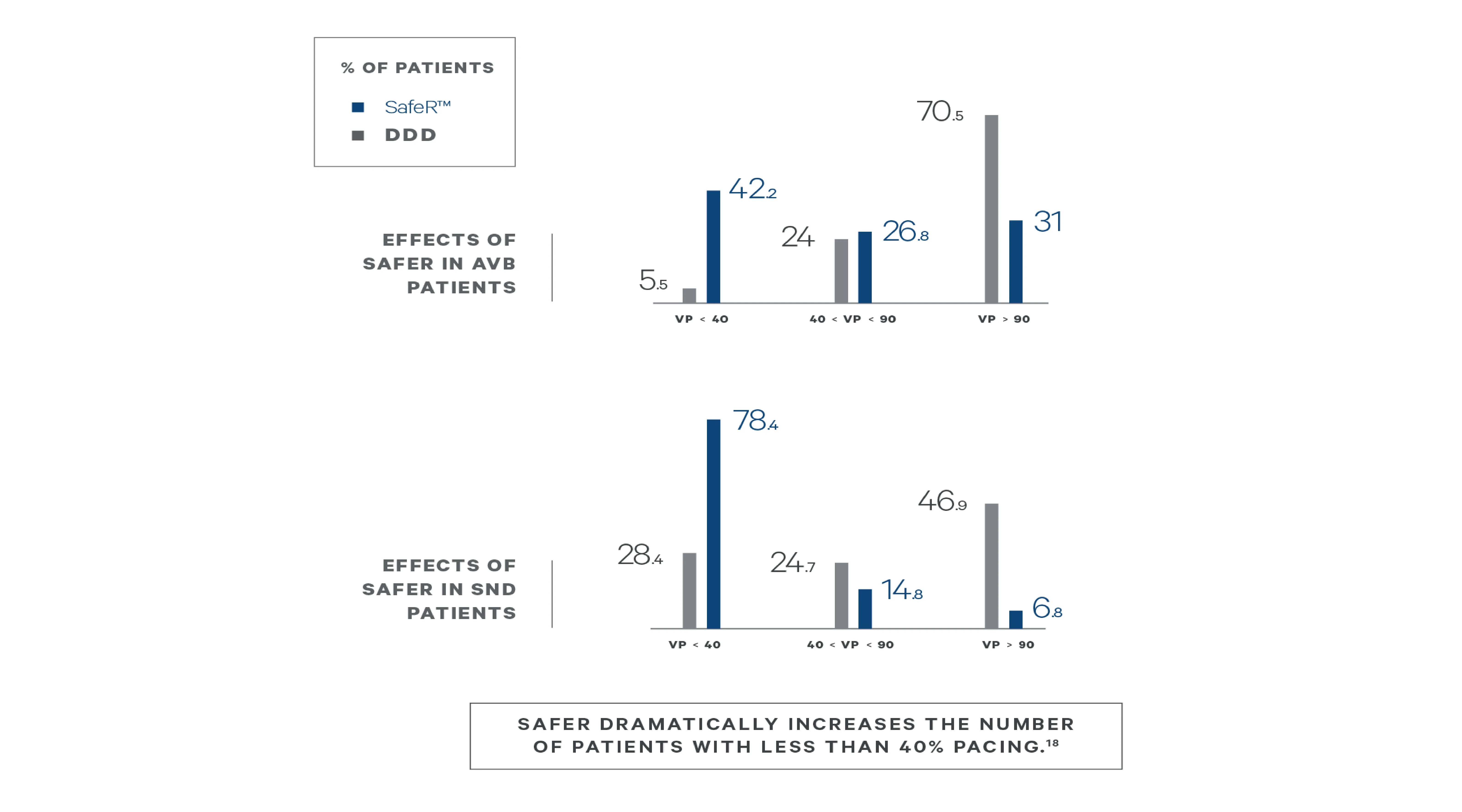
Minimiza significativamente la estimulación ventricular en pacientes con ENS y también en pacientes con BAV.

Descubra esta terapia
Dual

Dual Sensor™

Diseñado para modular fisiológicamente el ritmo cardiaco mediante la combinación de los sensores acelerómetro y ventilación por minuto.

Descubra esta terapia

SafeR™

  • Gestión avanzada del IAV para una mayor protección4, 5–11
  • Reduce la estimulación de VD en los pacientes con ENS y con bloqueo AV4
  • Gestiona todos los tipos de bloqueo AV en reposo y en ejercicio1, 4
  • Añade 2 años a la longevidad del dispositivo10, 11
  • Diagnóstico exclusivo de los bloqueos AV
REPLY Kora3 1

Doble sensor

  • Se ajusta a las necesidades metabólicas. Realización de ejercicio con seguridad
  • Diseñado para modular fisiológicamente el ritmo cardiaco mediante la combinación de sensores acelerómetro y ventilación por minuto

This product is not available for sale or distribution in the USA. For further information on product availability, please contact your local representative.

REFERENCIAS

  1. Manuales de implante (Reply – 0979-0980-O981-O982) disponibles en www.microportmanuals.com
  2. Comparación con fabricantes de sistemas de estimulación transvenosos realizada en septiembre de 2020. Véanse los manuales de los fabricantes disponibles online
  3. Reply en condiciones típicas con SafeR: 50% estimulación A, 5% estimulación V, SAM activada, 60 lpm, 2.5V, 0.35 ms, 750 ohmios, EGM y diagnóstico activados, sensores activados.
  4. Stockburger M, et al. Long-term clinical effects of ventricular pacing reduction with a changeover mode to minimize ventricular pacing in general population (ANSWER study). Euro Heart J. 2015;36:151–57.
  5. Andersen HR, et al. Long-term follow-up of patients from a randomized trial of atrial versus ventricular pacing for sick-sinus syndrome. Lancet. 1997; 350:1210-16.
  6. Skanes AC, et al. Progression to chronic atrial fibrillation after pacing: The Canadian Trial Of Physiologic Pacing (CTOPP). J Am Coll Cardiol. 2001; 38:167–72.
  7. Nielsen J, et al. A randomized comparison of atrial and dual chamber pacing in 177 consecutive patients with sick sinus syndrome. J Am Coll Cardiol. 2003; 42:614–23.
  8. Sweeney M, et al. Adverse effect of ventricular pacing on heart failure and atrial fibrillation among patients with normal baseline QRS duration in a clinical trial of pacemaker therapy for sinus node dysfunction. Circulation. 2003;107: 2932–37.
  9. Wilkoff BL, et al. Dual-chamber pacing or ventricular backup pacing in patients with an implantable defibrillator: the Dual Chamber and VVI Implantable Defibrillator (DAVID trial). JAMA. 2002;288:3115–23.
  10. Stockburger M, et al. Safety and efficiency of ventricular pacing prevention with an AAI-DDD changeover mode in patients with sinus node disease or atrioventricular block: impact on battery longevity-a substudy of the ANSWER trial. Europace 2016;18:739–46.
  11. Benkemoun H, et al. Optimizing pacemaker longevity with pacing mode and settings programming: results from a pacemaker multicenter registry. Pacing Clin Electrophysiol 2012;35:403–08.